

One piece.
Nothing to attach. Nothing to screw on afterwards.
Built for immediate loading.
Fixo has delivered an integrated multi-unit abutment since 2018. The abutment is part of the body. There is no implant–abutment joint to seat.
- 3030Ncm
- Torque on the M1.8 prosthetic screw
- 33
- Angulations: 0°, 17° and 30°
- 0.90.9mm
- Single-start thread pitch
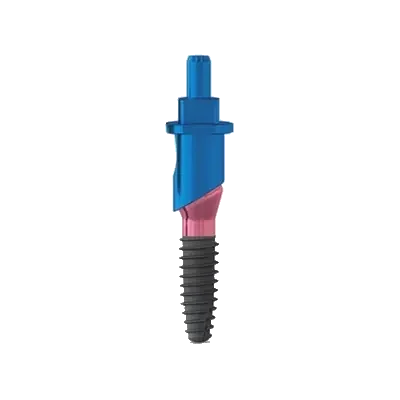
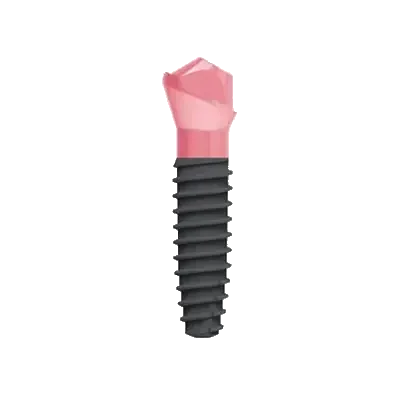
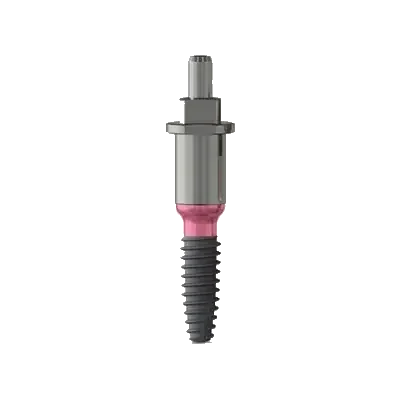
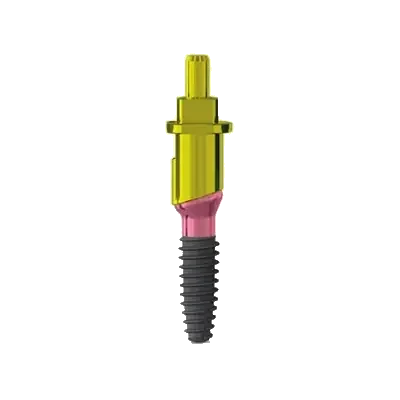
The multi-unit is part of the implant. There is no separate connection to check on a radiograph.
No abutment screw to seat. The multi-unit is machined with the fixture.
A pink neck. Coloured to sit more quietly in the soft tissue.
Guided or freehand. A straight Ø 5 mm mounter for the sleeve. Directional pins when you are working freehand.
Grade 4 titanium. Cold drawn, with the AMS surface.
The FIXO family
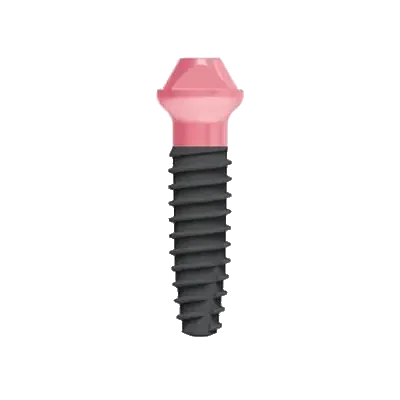
FIXO
Ø 3.5, 4.0, 4.5 mm Chamfer Ø 4.8 mm 0°, 17°, 30°
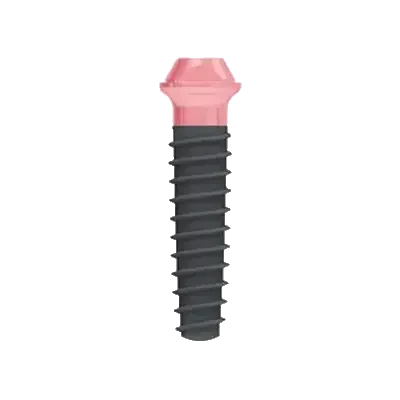
Mini
Ø 3.0, 3.5 mm Chamfer Ø 4.0 mm 0° and 17° only
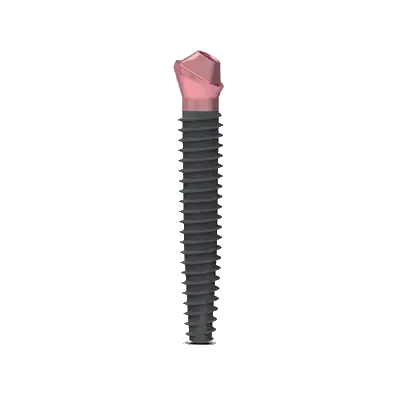
Pterygo
Ø 4.0 mm, 30° Short collar 19 to 25 mm
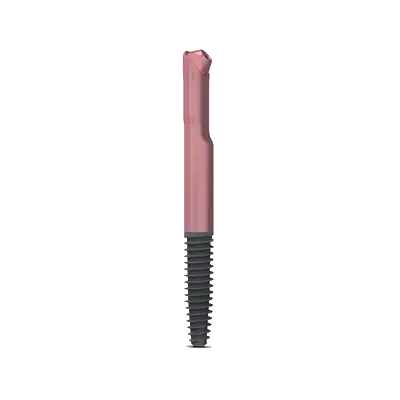
Zygoma
52° For zygomatic anchorage
Pterygo is Ø 4.0 mm at 30°, short collar, 19 to 25 mm. Zygoma is 52°, for zygomatic anchorage.
Thirty seconds
Most implants used for a screw-retained bridge need a separate abutment. FIXO does not: the multi-unit abutment is part of the implant, at 0, 17 or 30 degrees. The plan puts a window in each guide sleeve, facing where the bridge screw should come out. FIXO arrives with a colour-coded carrier over the angled head. Turn it until that carrier seats and its opening meets the window. Unscrew, lift the carrier off, and the abutment is where the plan put it.
Fixo. One piece.
Turn until the opening meets the window.
Drag the opening, or use the control
Drag until the mark meets the window at the top of the sleeve.
01
One piece, not implant then abutment
On a conventional full-arch workflow the multi-unit abutment is a separate part, screwed on after the implant is in. FIXO is machined as one piece, so that connection is not there to seat.
02
The angled head points where the implant stops
The prosthetic screw sits on the abutment axis. At 17° or 30° that axis is tilted, so the screw hole points wherever the implant stops turning.
03
The plan is built into the guide
Each metal sleeve has a side window. Planning sets that window towards the position the bridge screw should come out of. Flats stop the sleeve twisting in the guide.
04
A straight carrier over the angled head
FIXO arrives with a coloured mounter already screwed on. The outside is a straight 5 mm cylinder on the implant axis, so the driver and the sleeve still work straight, even though the head is angled.
05
Turn until the opening meets the window
Drive the implant until the mounter collar meets the top of the sleeve and the opening in the mounter lines up with the window. At that point the screw hole points the planned way.
06
Unscrew, lift, take the guide off
Undo the mounting screw through the window, lift the mounter off, and remove the guide. The abutment is already where the bridge needs it.
07
The bridge lands on the plan
Screw-retained bridgework then seats on the integrated abutments. A 0° FIXO does not need this rotational step: its screw hole is already on the implant axis.
Specifications
| Type | One-piece implant with an integrated multi-unit abutment |
|---|---|
| Material | Grade 4 titanium, cold drawn |
| Surface | AMS (Advanced Micro Surface): chemical etching, decontamination and cold argon plasma |
| Mounter | Single-use, pre-assembled, 5.0 mm outside diameter, straight on the implant axis |
| Mounter colours | Grey 0°, yellow 17°, blue 30° |
| Prosthetic screw | M1.8, tightened to 30 Ncm |
| MUA platform | 4.8 mm chamfer |
| Collar | Pink anatomical collar |
| Guided surgery | 5.0 mm mounter works through a guide sleeve. Pcube is Biomec's stackable system. |
| Certification | MDR (EU) 2017/745 for the OXY lines, December 2022 |
| Made in | Colico, Italy, by Biomec. In-house design and machining. |
| Warranty | To be confirmed |
PlaceholderWritten warranty terms are still to be confirmed.